Archive for falls

I am ‘fully persuaded that many lives would be saved’: Children falling from windows then and now

Posted in Accident, Bills of Mortality, Newspapers, Uncategorized with tags , on 13/08/2025 by Craig Spence

On 13 August 2025, BBC News reported the publication of a report by the UK’s NHS-funded National Child Mortality Database. The quote above is not, however, taken from that report. It is, in fact, from a letter sent to The Gentleman’s Magazine in January 1751. The anonymous letter writer expressed concerns for childhood deaths that occurred through accidental falls from windows and burns from stoves. Despite the nearly three hundred years that separate the report, the letter, and the deaths they encompass the circumstances remain tragically alike.

Between 1655 and 1735, the Bills of Mortality reported that 209 people died after falling accidentally from windows. The number of others who were injured but survived after such events is not known. Given the severity of injuries often sustained in falls from height, however, it is likely that most falls during the period proved fatal.

The sense one gets from reading associated evidence is that women and children were at particular risk. To give some examples, in late April 1657, a girl named Penelope Bayley fell from a window and died in Dorset Garden in St Bride’s parish south of Fleet Street.

The London Archives: P69/BRI/A/005/ MS06540/001 (5 May 1657)

Also in late April, but this time in 1673, a child named William Pen died after falling out of a window in the City of London parish of St Katherine Cree.

The London Archives: P69/KAT2/A/001/MS07889/001 (2 May 1673)

In the parish of St Mary Newington in Southwark, a girl was reported, in the Bill of Mortality of 22nd October 1706, to have fallen from a window and died. While the parish register does not provide a cause of death, it is likely to have been Mary Austwick, daughter of William Austwick, who was buried on 24 October of that year.

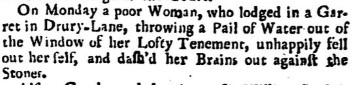
In a final example, evidence is derived from a contemporary newspaper, the Original Weekly Journal. In December 1717, it reported the death in the parish of St Giles in the Fields of an unnamed ‘poor woman’ who ‘throwing a pail of water out of the window of her lofty tenement, unhappily fell out herself’.
The BBC article notes the observation of Dr Noelle Mottershead, paediatric consultant at Manchester Royal Infirmary, that more children with window fall-related injuries presented in the first half of 2025 than usual. The implication is made that the exceptionally hot spring weather was to blame. This is a well-placed observation, as across the 75 years of Bills of Mortality evidence, the peak season for window fall fatalities was the spring, while the peak month was May (27 reports). Although detailed weather information is not available for the early modern period, it is clear that seasonally warmer days accompanied by ‘spring cleaning’ and associated maintenance activities likely encouraged the opening of windows that, in the preceding winter months, had been kept firmly shut.

There is yet another unsettling parallel between the concerns of the anonymous author of the 1751 letter and modern-day incidents: building technology. The letter in The Gentleman’s Magazine noted that ‘It is well known that many families in London are obliged to live upstairs, one, two or three stories … we hear of dreadful accidents by children falling through the windows, or by the sashes being lifted open, and the unhappy young things left (by carelessness) to gaze at … something’ falling out.

Sashes were a relatively new form of window in the early 18th century, though by mid-century they had become a common design element in newly constructed buildings across the metropolis. The author of the letter goes on to suggest fixing the lower sash in place and opening the upper would hinder many accidental falls, effectively proposing the functional equivalent of modern window restrictors.

Whether 300 years ago or today, children falling to their deaths from poorly designed, faulty, or improperly operated windows remains a concern. Contributing factors include the need for ventilation in poorly designed accommodation, especially during periods of hotter weather, and lapses in appropriate maintenance actions. Also, it is clear that while status might not be considered relevant in all cases, whether then or now, social deprivation remains a critical driver of many events.

Such deaths were, for the most part, avoidable then. Such deaths should be avoidable now. As the anonymous letter writer of 1751 observed, by the application of some simple measures, they were ‘fully persuaded that many lives would be saved’.
A time when smoking could result in sudden death

Posted in Accident with tags , , on 13/11/2019 by Craig Spence

Between 1671 and 1730 at least seventeen Londoners died as a result of smoking. This may not seem particularly surprising to modern eyes but at that time the consumption of tobacco was enjoyed by smoking it in clay pipes rather than cigarettes (or their e-version), and it was the pipe rather than the nicotine that presented an immediate hazard. Such pipes were manufactured in fire-hardened clay and comprised a relatively small bowl with a very long narrow stem. Contemporary images, together with osteo-archaeological evidence indicating long-term dental abrasion, make it clear that people from a wide range of backgrounds enjoyed smoking such pipes. But with a tobacco pipe firmly clamped in the mouth any unexpected fall or stumble could easily cause injury or even death.

In October 1702, for example, a woman in Westminster died after her ‘tobacco pipe struck accidentally into her brain’. The following year during the month of March a man in the parish of St Peter Paul’s Wharf died after his tobacco pipe ‘accidentally struck [him] in the throat’. The fact that falls were most frequently associated with this form of death is given weight by the Bill of Mortality for 17 November 1730 which reports quite unequivocally that a ‘man [was] accidentally killed by a tobacco pipe after a fall’ in St Dunstan Stepney. Violent behaviour can sometimes be linked to a tobacco pipe death. To give a pretty disturbing example, in the parish of St Giles Cripplegate in May 1719 ‘Hannah Harris[on], spinster, [was] killed with a tobacco pipe’. Her death was the result of being accidentally stabbed just below her left eye with the stem of her father’s pipe during an argument over money.

So, while smoking tobacco may not have been recognised as a health concern in its own right during the eighteenth century (even though many perceived it as a social annoyance) being stabbed in the head with a tobacco pipe was clearly something it was best to avoid.

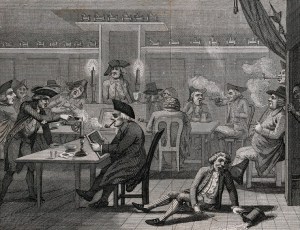
Smokers and drinkers in tavern. One has fallen to the floor, has spilled his beer and broken the stem of his pipe.

This engraving shows a group of men enjoying beer and tobacco around 1790. The fallen man has luckily broken his tobacco pipe on the ground rather than driving it into his brains! (Wellcome Collection CC BY – Etching by J. Barlow, 1790, after S. Collins)

This week in 1684 AND 1685: Plastering, ladders and a terrible coincidence

Posted in Accident, Bills of Mortality with tags , , , , , on 13/05/2012 by Craig Spence

As reported by the London Bills of Mortality for the week of 13th May 1684:

2 drowned one at St Katherine by the Tower and one at St Mary Magdalen Bermondsey;
1 by a fall from a ladder at St Giles without Cripplegate.

As reported by the London Bills of Mortality for the week of 12th May 1685:

1 drowned at St Katherine by the Tower;
1 killed by a coach at St Martin in the Fields;
1 accidentally killed by the wheel of a crane at St Sepulchre [without Newgate];
1 by a fall from a ladder at St Giles without Cripplegate.

Here we see information on two separate weeks taken from the London Bills of Mortality exactly one year apart. The observant will have already noticed that both weeks have some things in common; drownings at St Katherine by the Tower and deaths caused by falling from ladders. The coincidences have however only just begun. Let’s set aside the drownings, which were so frequent on the Thames that such similarities are often encountered in the Bills, and instead focus on the ladder casualties.

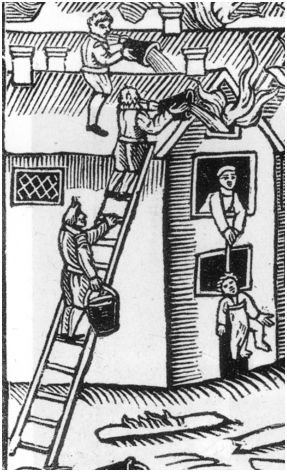
A 17th century ladder in use for fire fighting: Such ladders claimed the lives of 88 Londoners between 1654 and 1735.

What is evident from these reports are that both falls took place in the same parish, St Giles Cripplegate, yet given the size of that suburban parish this is perhaps not so surprising. The real coincidence comes when reference is made to the parish burial register. Here we find that the victim in 1684 was a plasterer named James Fox, the victim in 1685 was a man named John Cooper who we find was – and here’s the real coincidence – also a plasterer. So we have two men in the same occupation both falling to their deaths from ladders, in the same place and exactly one year apart. One suspects that for those who could remember the earlier event the 1685 incident gave them plenty to contemplate!

Between 1654 and 1735 the Bills of Mortality record the deaths of eighty-eight individuals who fell from ladders. This was not however the most significant cause of fatal falls, that was actually the more mundane situation of falling down stairs (which claimed 216 victims). Falling from ladders was however almost certainly related to occupational activities and hence we find bricklayers, carpenters painters and plasters in the accounts of ladder-related accidents. It is also notable that falls in these occupations also peaked during the months of May – the start of the building season – and again in August through to October – as building worked became intensified before winter weather curtailed such activity.

This week in 1728: Falling out of windows and into gin!

Posted in Accident, Bills of Mortality with tags , , , on 05/03/2012 by Craig Spence

As reported by the LondonBills of Mortality for the week of 5th March 1728:

1 bruised by a fall from a window at St Katherine Coleman;
1 found dead at St George the Martyr [Southwark];
1 found in the River of Thames, a boy unknown, buried at St Olave Southwark;
1 scalded in a distillers copper, a young man, at St James Clerkenwell.

A small but interesting group of fatalities from this first week of March in 1728. Falls from buildings, and especially windows, tended to occur disproportionately often during this first quarter of the year throughout the later 17th and early 18th centuries. Perhaps the first glimpses of warmer weather enticed people to open windows previously kept firmly shut against the colder weather, or maybe it just represents the recommencement of construction activity after the winter ‘break’.

Although adults were often found washed up on the shores of the Thames it was rarer to encounter the body of a child. Whether such fatalities were suicides, accident or murder victims was hard to tell, in this case however the first category might be fairly safely omitted. Finally the young man scalded to death was most likely a distiller’s (or brewer’s) servant or possibly apprentice. Just goes to show that it wasn’t only the consumers of gin who suffered early deaths but, as on this occasion, it could also be the manufacturers.

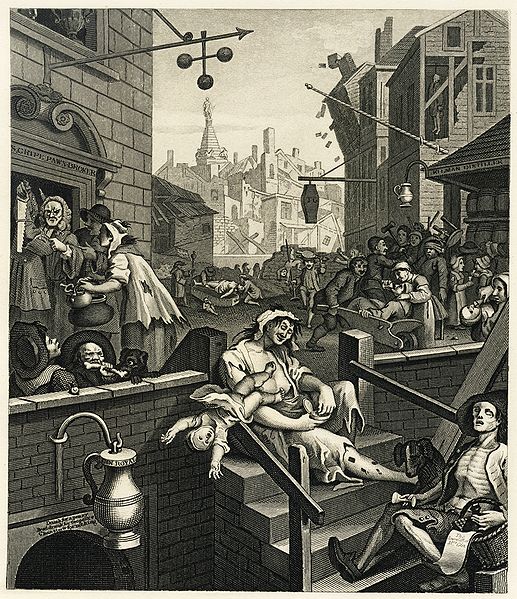
Hogarth’s ‘Gin Alley’ engraving of 1751 depicts the detrimental affects of gin but in this case on the consumers not the producers. We will return to this, and other of Hogarth’s works, in future posts as they often feature aspects of violent death in the metropolis.